
International UAS exam
The International UAS Exam is a joint digital entrance exam of the Finnish Universities of Applied Sciences (UAS), used for selecting students to study programmes leading to a bachelor’s degree and conducted in English. The entrance exam is completed by the applicant’s own computer remotely online.
In the spring’s joint application, 91 study programs use the International UAS Exam; please see further information on them here. Regardless of how many study programs you’re applying for, you only need to participate in the International UAS Exam once.
In the International UAS exam, the applicants’ readiness for UAS studies is assessed. The exam does not include any advance reading materials or pre-assignments.
The International UAS exam is used in the following study fields:
- Humanities and Education
- Business Administration, Business Information Technology (BIT)
- Natural Resources
- Tourism and Hospitality
- Seafaring
- Social Services, Health Care, Sports and Exercise, Beauty Care
- Technology
Please check in Table 1 whether your targeted study programmes use the International UAS exam. If your targeted study programme does not use the exam, please refer to Studyinfo.fi for more information on the programme and admission criteria. In that case, please check whether the programme involves a pre-assignment or a separate entrance exam requiring preparation.
Language requirements
In order to be invited to the International UAS Exam and to be selected based on the International UAS Exam selection method, the applicants have to prove their English language skills either by an internationally recognized language test or previous studies.
English language skills can be proved by the following documents:
- English language test results:
- IELTS Academic*: a minimum total score of 6.0 (Test sections: Listening, Reading, Writing, and Speaking)
- TOEFL Academic (iBT)*: a minimum total score of 60 (Test sections: Reading, Listening, Speaking, and Writing)
- PTE Academic*: a minimum total score of 55 (Test sections: Speaking and Writing, Reading, and Listening)
- Cambridge English Scale Score: a minimum total score of 169 (Test sections: Reading and Use of English, Writing, Listening, and Speaking)
- National Certificate of Language Proficiency (YKI) English: Grade 4 or higher on all the subtests (speaking, listening comprehension, writing, and reading comprehension)
- Higher education degree completed in English in an EU/EEA country, Australia, Canada, New Zealand, Switzerland, United Kingdom, or the United States
- Upper secondary degree completed in English in an EU/EEA country, Australia, Canada, New Zealand, Switzerland, United Kingdom, or the United States
- One of the following grades in the Finnish Matriculation Examination, European Baccalaureate, International Baccalaureate or Reifeprüfung/DIA:
- Finnish Matriculation Examination: English advanced syllabus with a minimum grade M
- The whole International Baccalaureate degree completed in English
- International Baccalaureate final examination: higher level English with a minimum grade 4
- European Baccalaureate: at least grade 6.00 in L2-level English
- Reifeprüfung/DIA completed diploma: at least grade 7 in advanced English
* IELTS Academic UKVI, IELTS Online, PTE Academic Online and TOEFL iBT Home Edition are also accepted.
Only the tests listed above will be accepted. No exceptions will be made.
There are no expiration dates, but the language test results must be verifiable from the online verification service of the organiser. The TOEFL test cannot be verified after two years. The IELTS test cannot be verified after three years. If the test scores can no longer be verified, the test is not valid. The applicant should make sure that the test results are not too old. If the applicant is unsure and the test results are more than 2 years old, it is advised to retake the test.
Point 1 above: When taking the language test, the applicant should choose the university of applied sciences that uses the International UAS Exam as the recipient of the results, if possible. The results must be at least sent to the university of applied sciences that is listed highest on the list of targeted study programmes in the application form. If possible, the test results should be sent to every university of applied sciences using the International UAS Exam where the applicant has applied to. The applicant must also attach a scanned/electric copy of the test result to the application for verification purposes, and notify their unique identifier.
Point 2 above: If applying with the National Certificate of Language Proficiency (YKI), the unique identifier is not necessary. However, the applicant must attach a scanned/electric copy of the test result to the application for verification purposes.
Points 3-4 above: The applicant must attach a certificate of their previous degrees. The applicant must also attach a document that shows the language of the degree and the country of studies.
Point 5 above: The applicant must attach a certificate of their grades.
Identification documents
The applicant needs a valid, acceptable identification document to be able to participate in the International UAS Exam. The following documents are accepted as proof of identity:
- A passport. The passport can be either biometric or non-biometric.
- A biometric EU/EEA identity card. The EU/EEA identity card must have a biometric symbol, as shown below
No other forms of identification documents are accepted. For example, residence permit cards or non-biometric EU/EEA identity cards will not be accepted.
The passport/identity card has to be valid.
In the biometric EU/EEA identity card, there is a symbol indicating biometric features. The symbol is located on either the front or back side of the biometric identity card.

You have to provide the number of your passport or biometric EU/EEA identity card to the application form (passport or EU/EEA ID card (UAS) section) during the application period. You must attach a copy of both sides of the EU/EEA identity card to your application form. If the information you submit is incorrect or you do not submit this information to the application by the given time limit, you cannot participate in the International UAS exam and thus not proceed in the International UAS Exam selection process.
Exam sections, duration and scoring
The entrance exam is conducted in the English language. The exam sections and duration of the exam are determined on the basis of the study programmes you apply for. You complete at one time all the exam sections that are included to the study programmes you apply for. The entrance exam includes both common exam sections to all study programmes and field-specific exam sections. The exam sections for each study field are presented in the chart below. A total score of the exam is the sum score of the exam sections included to your study programme. In order to be selected, you must pass all the exam sections (i.e. reach the minimum pass score per section).
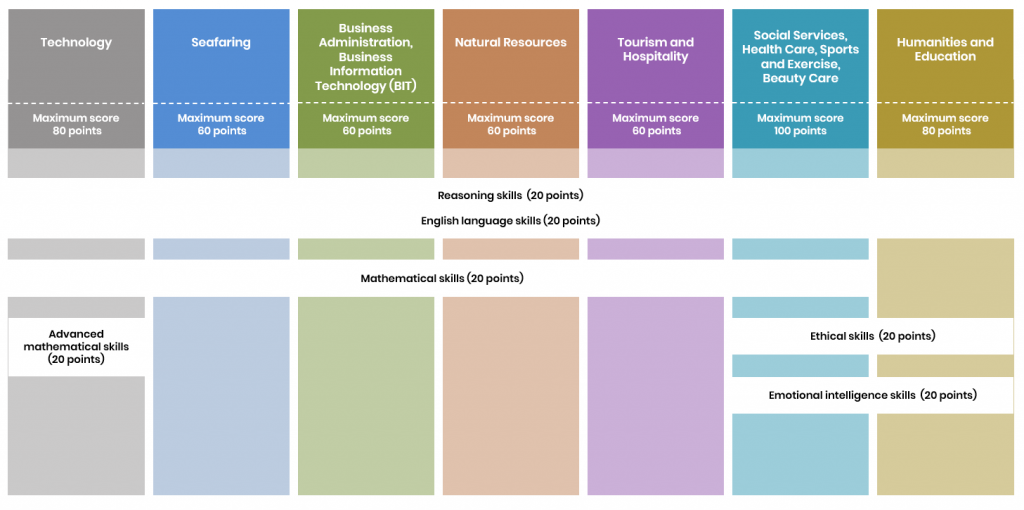
A specific response time has been allocated for each exam section. When the section-specific time is up, the section will close. If you don’t finish the section, its latest version will be saved as your answer. You can complete the sections in any order. However, please note that once a section is opened, it needs to be completed, and you cannot return to the section later. In addition to the section-specific times, there is 15 minutes for transitions between sections in the exam.
Common exam sections to all study programmes:
- Reasoning skills (25 minutes): You have to complete this exam section regardless of the programme you apply for. The section assesses your logical reasoning and problem-solving skills. The maximum score in this section is 20 and the minimum pass score is 1. NB. The minimum pass score in the section has changed to 0.1 points due to the difficulty level of the section (information updated on April 10, 2024). Penalty scores (wrong answers produce minus points) are used in this section. You can also leave a question unanswered. Please have a look at the reasoning skills example questions.
- English language skills (20 minutes): You have to complete this exam section regardless of the programme you apply for. The section assesses your skills in reading and interpreting texts, such as understanding the relation between different parts of the text, mastering vocabulary and linguistic reasoning. The maximum score in this section is 20 and the minimum pass score is 3. Penalty scores (wrong answers produce minus points) are used in this section. You can also leave a question unanswered. Please have a look at the English language skills example questions.
Field-specific exam sections:
- Mathematical skills (25 minutes): This exam section is required for the fields of Technology, Business Administration and BIT, Natural Resources, Tourism and Hospitality, Seafaring, Social Services, Health Care, Sports and Exercise and Beauty Care. The contents of the section are the same for all the above-mentioned fields. In this section, your basic mathematical skills are assessed. The focus is on basic calculations, calculating percentages, first-degree equations, geometry, mathematical-logical reasoning and interpreting tables, graphs and diagrams. In this section, you are allowed to use the function calculator of the examination system. The maximum score in this section is 20 and the minimum pass score is 1. Penalty scores (wrong answers produce minus points) are used in this section. You can also leave a question unanswered. Please have a look at the mathematical skills example questions.
- Advanced mathematical skills (30 minutes): This exam section is required for the field of Technology. The section assesses your abilities in mathematics and physics. Your mathematical skills are assessed by questions related to reducing rational expressions, solving equations, level geometry and trigonometry (e.g. right-angled triangle). Your physics skills are assessed by questions related to basic knowledge in physical phenomena and calculation formulas, your ability to calculate and reason on the basis of basic physical knowledge and given models, and your ability to interpret charts, graphs and diagrams. In this section, you are allowed to use the function calculator of the examination system. The maximum score in this section is 20 and the minimum pass score is 1. NB. The minimum pass score in the section has changed to 0.1 points due to the difficulty level of the section (information updated on April 10, 2024). Penalty scores (wrong answers produce minus points) are used in this section. You can also leave a question unanswered. Please have a look at the advanced mathematical skills example questions.
- Ethical skills (10 minutes): This exam section is required for the fields of Social Services, Health Care, Sports and Exercise, Beauty Care, and Humanities and Education. The contents of the section are the same for all the above-mentioned fields. In this section, your skills in recognising the ethical nature of statements are assessed. The maximum score in this section is 20 and the minimum pass score is 1. Penalty scores (wrong answers produce minus points) are used in this section. You can also leave a question unanswered. Please have a look at the ethical skills example questions.
- Emotional intelligence skills (10 minutes): This exam section is required for the fields of Social Services, Health Care, Sports and Exercise, Beauty Care, and Humanities and Education. The contents of the section are the same for all the above-mentioned fields. In this section, your capabilities in emotional intelligence skills, such as recognizing and controlling emotions, are assessed. The maximum score in this section is 20 and the minimum pass score is 1. Penalty scores (wrong answers produce minus points) are used in this section. You can also leave a question unanswered. Please have a look at the emotional intelligence skills example questions.
Chart 1. Exam sections.